
Wrought Iron Fence Installation on Sloped Knoxville Lots: A Step-by-Step Guide
Wrought iron fence installation gets harder the minute your yard stops being flat. In the Knoxville foothills, that describes a lot of yards. Iron panels are rigid, heavy, and unforgiving on grade changes, so a slope that a chain link fence would shrug off can leave an iron fence with gaps under the panels or a top rail that staircases awkwardly across your view. This guide walks through the installation step by step, written for East Tennessee ground: clay and rock under the surface, grade that rises and falls, and the two issues that make Knoxville homeowners nervous before any fence goes in, property lines and pool gate code. Understanding how to manage sloped lot fence installation keeps your fence level, your pool inspection on schedule, and disputes with neighbors minimal.
If you own a pool, the slope question matters twice. A gap under a fence panel on a downhill run is not just ugly; it can fail a pool barrier inspection. So this guide treats slope, boundaries, and gate compliance as one connected job, because on a foothills lot, they are.
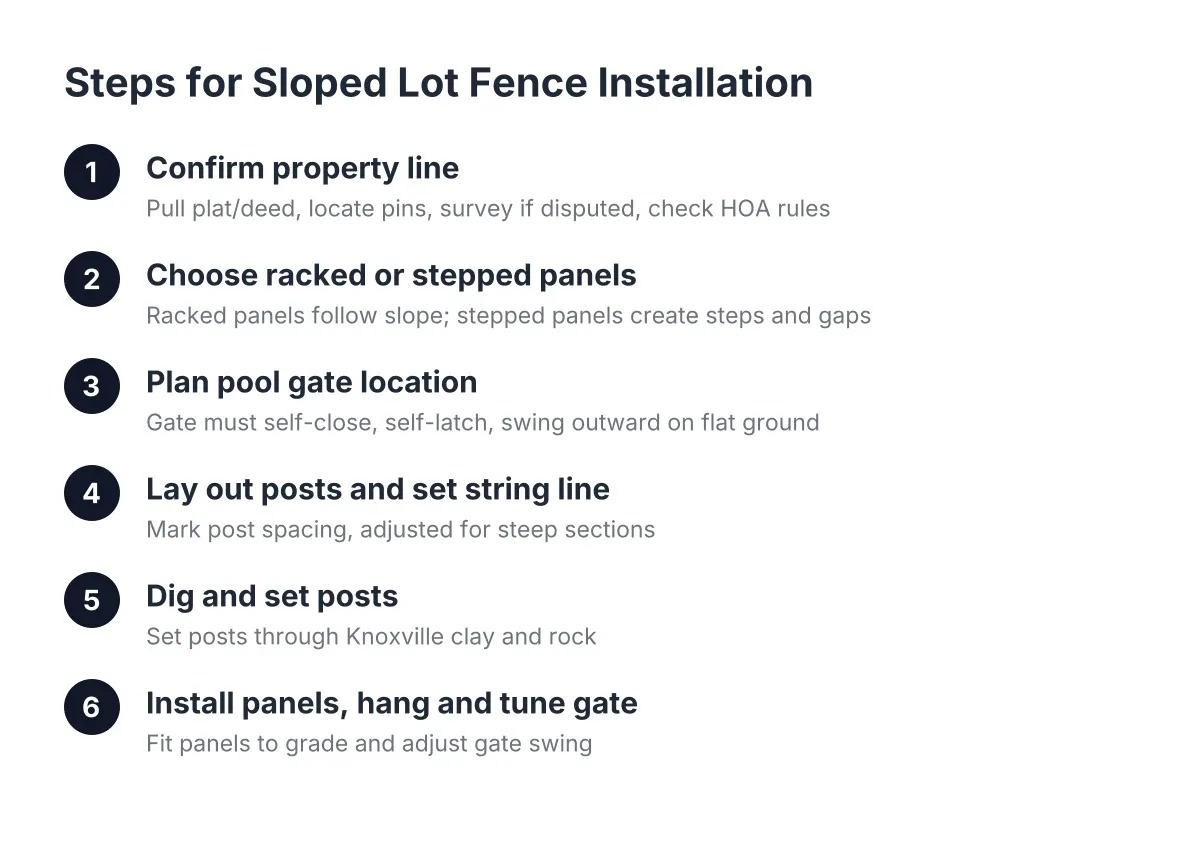
Step 1: Confirm Your Property Line Before Anyone Digs
Start here, not with the fence. On sloped lots especially, the visual cues people use to guess at a boundary, like an old fence line, a tree row, or where the neighbor mows, drift over time and rarely match the recorded line. If you set iron posts in concrete a foot over the line, moving them is expensive and awkward, and iron posts do not relocate the way wood posts do.
A few practical moves before layout day:
- Pull your plat or deed. Many Knox County properties have a recorded plat showing boundary dimensions, and your closing documents may include a survey.
- If pins exist, find them. Surveyors set iron pins at corners; a metal detector sometimes locates them under a few inches of soil.
- When the line is disputed or unclear, pay for a survey. It costs money on top of the fence, but it is cheap compared to tearing out and resetting a run of iron panels set in concrete.
- Talk to the neighbor before layout, not after. Showing them the survey and the planned line, even informally, heads off most shared-fence disputes. Keep notes or an email trail as documentation.
Also check setback requirements and HOA rules. Some Knoxville subdivisions regulate fence height, style, and placement relative to the line, and an ornamental iron fence usually needs HOA approval in communities that have an architectural review process. Get that approval in writing before you order material.
Step 2: Choosing Racked or Stepped Panels for Sloped Lot Fence Installation
Next, figure out how your grade actually moves, because it dictates the panel style you buy. Walk the fence line and note where the ground falls, how fast, and whether the slope is steady or rolling. A string line stretched tight between stakes at each end of a run shows you the drop at a glance.
You have two ways to handle grade with iron:
- Racked (rackable) panels. The pickets stay vertical while the rails pivot to follow the slope. The bottom rail hugs the ground, which keeps gaps small. Most rackable panels handle moderate slopes; steep foothill grades can exceed what a standard panel will rack.
- Stepped panels. Each panel stays level and the fence drops in steps from post to post. This looks formal and crisp, but it opens triangular gaps under the downhill end of each panel.
For a pool enclosure, racked panels are usually the safer choice. Pool barrier rules limit the gap under the fence, and stepped panels on a real slope can exceed that limit fast. If you want the stepped look anyway, plan on filling the gaps with grading, retaining edging, or custom-cut sections, and confirm the approach with your inspector before you build. On steep sections where sloped lot fence installation narrows post spacing, full-length rails may not reach into the post routing at the angle required, so post spacing often needs to shrink.
Shorter panels on the steep stretch, full panels on the flatter stretches. Experienced installers put the cut or shortened sections in the least visible part of the yard and save full panels for the street-facing run.
Step 3: Plan the Pool Gate Location for Code Compliance
If the fence encloses a swimming pool, the gate is the part the inspector studies hardest. As of 2026, pool barrier requirements in most Tennessee jurisdictions follow the same core logic: the gate must be self-closing and self-latching, it must swing outward away from the pool, and the latch release must sit high enough that a small child cannot reach it. Confirm the exact requirements with your local codes office or inspector, because enforcement details vary and this article is not a substitute for their sign-off.
Slope changes where the gate can go. A self-closing gate needs to close reliably from any open position, and a gate hung on a grade wants to swing downhill on its own or fight the closer going uphill. Put the gate on the flattest ground available, even if that means walking a few extra steps from the patio. If the only workable spot has grade, the posts and hinges must be set so the gate swings level, which usually means building up or cutting the grade at the gate opening.
Suppose a homeowner in a West Knoxville subdivision is finishing a pool this spring with an inspection deadline. The pool contractor handles the deck and equipment but refers the barrier out. In that scenario, the fence crew's first question should be where the inspector wants the gate and what latch height applies, not what panel style looks best. Getting the gate right first keeps the inspection on schedule; the decorative decisions can flex, the code items cannot.
Step 4: Lay Out Posts and Set a String Line Across the Grade
With the line confirmed and the panel style chosen, mark post locations. Measure panel widths from your manufacturer, then adjust spacing on steep sections as noted in Step 2. Mark each post location with paint or a stake, and call 811 to have utilities located before any digging. On older in-town Knoxville lots, buried lines do not always run where you would expect.
Then set a string line across the tops of the planned posts. Because driveways, walks, and yard grade all carry pitch, the string gives you a consistent reference for post height above grade so the fence follows the ground uniformly instead of wandering. On a racked installation, you want the top of the fence to parallel the slope at an even height; the string is how you hold that line.
Step 5: Dig and Set Posts in Knoxville Clay and Rock
Here is where East Tennessee ground earns its reputation. Clay holds water in wet springs and shrinks in dry summers, and shallow rock can stop an auger cold. Dig post holes below the typical frost depth for the area and wider at the bottom than the top where possible, so freeze-thaw cycles grip the concrete instead of heaving it. If you hit rock, you may need a rock bar, a core drill, or a relocated post; forcing a shallow post is how gates sag two winters later.
On sloped ground, set each post plumb, then check its height against the string line. A post on a cross-slope sometimes needs backfill built slightly higher on one side so the rails seat level in the routing despite the grade changing around it. Work downhill in a consistent direction, dry-fit each panel before the concrete cures on the next post, and confirm the panel tops run even with the section before it. Let concrete cure fully before hanging panels, and longer before hanging the gate, which puts real leverage on its post.
Step 6: Install Panels, Then Hang and Tune the Gate
Install panels starting from the most visible corner, keeping full panels on the prominent runs. On racked sections, rack each panel to the grade before fastening, and check the bottom rail gap as you go; on a pool enclosure, measure that gap at the low point of every panel, not just at the posts.
Hang the gate last. Mount the self-closing hinges per the manufacturer's tension instructions, set the self-latching hardware at the required height, and then test the gate the way an inspector will: open it a few inches and let go, open it fully and let go, and push it closed softly. It must latch every time on its own. On any grade at all, expect to adjust hinge tension more than once across the first few weeks as the posts and hardware settle.
Cost Factors for Wrought Iron Fence Installation on Slopes
Slope adds labor, and labor is the biggest variable in iron fence pricing. Expect the cost factors to stack like this: more posts from shortened spacing on steep runs, rock drilling or hand digging where the auger refuses, custom-cut panels at grade transitions, and extra grading at the gate. A true wrought iron fence, meaning solid forged iron rather than ornamental steel or aluminum, also costs more per foot than other fence materials and often involves longer lead times for custom panels and decorative sections.
For comparison, Angi reports wood fencing runs about $11 to $45 per linear foot professionally installed, and HomeGuide puts vinyl at $30 to $60 per linear foot. Iron sits above both, which is the honest trade-off: you pay a premium for a fence that reads as permanent and upscale, and for pool enclosures it rewards you with rigidity and sightlines that lighter materials cannot match. If the budget resists, an aluminum fence delivers a similar look with easier racking on slopes and lower material cost, at the expense of some heft and that forged character.
When homeowners search for wrought iron fence installers or a wrought iron fence near me, the useful filter is not distance; it is whether the installer talks about grade, soil, and gate code before talking about panel styles.
Questions to Ask Before Hiring Out the Work
Finally, whether you hire a local fencing contractor or tackle parts yourself, a few questions separate a careful iron fence installation from an expensive do-over:
- Will you work from a survey or recorded plat, and will you flag it if my planned line looks wrong?
- How will you handle the grade, racked panels, stepped panels, or a mix, and where will the cut sections go?
- What is your plan if you hit rock at post depth?
- How will the pool gate meet self-closing and self-latching requirements, and have you passed barrier inspections in Knox County before?
- Who handles HOA approval paperwork, and does work wait until it is in writing?
A contractor who answers those five questions specifically, with references to your actual lot rather than generalities, is the one who will set the fence on the right line, keep the inspector satisfied, and keep the peace with the neighbor on the other side of it.
If you need fence installation, Knoxville Fence Builders can help.
Prefer to talk it through? Call (865) 419-3997 — a quick call is usually the fastest way to get a straight answer for your situation.