
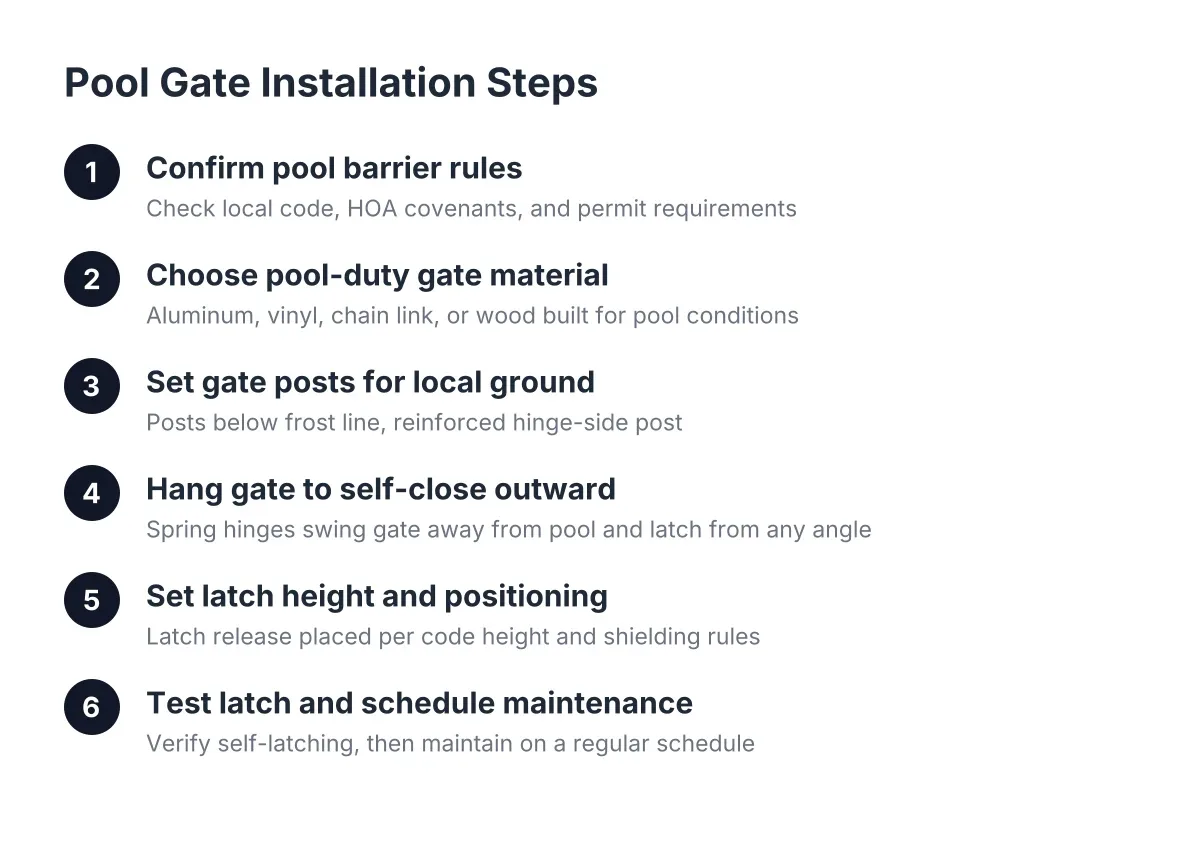
Pool Gate Installation in East Tennessee: Safety Codes and Pool Gate Latch Rules
A pool gate is the one part of a swimming pool fence that moves, which makes it the part most likely to fail a safety inspection. Whether you manage a community pool for an HOA or just put a pool in behind your new privacy fence, the pool gate latch is where codes get specific: how high it sits, which way the gate swings, and whether it closes and locks on its own. This guide walks through pool gate installation step by step, with the latch requirements that matter most in Knoxville and the surrounding East Tennessee area, so you know what a correct installation looks like before anyone digs a post hole.
One note before the steps. Codes vary by jurisdiction, and HOA pools often fall under stricter commercial rules than a backyard pool. Always confirm current requirements with your local codes office or a local fencing contractor before you build; the steps below reflect common 2026 residential pool barrier standards, not legal advice for your specific property.
Step 1: Confirm the Pool Barrier Rules That Apply to Your Property
Start by finding out which code governs your pool fence and gate. Most East Tennessee jurisdictions base their pool barrier rules on the International Swimming Pool and Spa Code or similar model codes. Common requirements include a fence at least four feet tall, gates that self-close and self-latch, and gates that swing outward, away from the pool.
For HOA and commercial pool areas, expect more scrutiny. A community amenity pool usually needs permits, inspections, and documentation that a single-family backyard pool may not. If you are a property manager replacing an aging pool enclosure, pull the current code requirements before you request bids. That way every bid prices the same compliant scope, and you are not comparing a code-ready gate against one that will fail inspection.
In addition, check your own HOA covenants. Some communities add rules on fence material, height, or color on top of what the county requires.
Step 2: Choose a Gate and Fence Material Built for Pool Duty
Pool gates take more abuse than any other gate on the property. They swing dozens of times a day in summer, they live next to chlorinated water, and the self-closing hardware puts constant spring tension on the hinges. Material choice matters more here than on a standard yard gate.
Common options for East Tennessee pool areas:
- Aluminum fence and metal fence gate: The most popular pool choice. It will not rot, handles humidity and splash, and pairs cleanly with self-closing hinges and a magnetic pool gate latch.
- Vinyl fence: Low maintenance and good for privacy around a pool. Vinyl gate frames need internal reinforcement to resist sagging, which a good installer handles with inserts inside the gate uprights.
- Chain link fence: Budget-friendly for large commercial perimeters. Pool gate latch hardware made for chain link exists, but confirm the latch model meets the self-latching height rule.
- Wood fence: Workable, but East Tennessee's humidity and freeze-thaw winters swell and shrink wood, which throws off latch alignment faster than other materials. A 6 ft wood fence gate around a pool needs seasonal adjustment to keep latching reliably.
One code detail that surprises first-time fence buyers: if your privacy fence doubles as the pool barrier, the horizontal rails must face inward, toward the pool side. Exposed rails on the outside act as a ladder for a child. Many homeowners want the finished picket side facing their own yard, and around a pool that preference loses to code.
Step 3: Set the Gate Posts for Knoxville Ground Conditions
Gate posts carry all the load, so this step decides whether your gate still latches correctly in five years. Knoxville's clay and rocky soil complicates digging, and the freeze-thaw cycle each winter heaves posts that were set too shallow. Posts should go below the frost line in concrete, with the hinge-side post sized and reinforced for the constant pull of a self-closing gate.
On vinyl gates, the hinge-side post is the one that needs a reinforcing insert; latch hardware rarely rips out of the latch-side post, but hinges under spring tension will. Sloped lots, common in the foothills around Knoxville, add another wrinkle: the gate opening must stay level even when the fence steps or racks down the hill, or the gate will drag or leave a gap underneath larger than code allows.
Therefore, if your pool sits on a slope or your soil is heavy clay, this is the step where hiring a pro pays for itself. A post that shifts half an inch can prevent the pool gate latch from catching properly, and an unlatched pool gate is the exact failure these codes exist to prevent.
Step 4: Hang the Gate to Self-Close and Swing Outward
Pool safety codes require the gate to open outward, away from the pool, and to close and latch on its own from any open position. Self-closing spring hinges handle this. During installation, the gate gets squared and pre-set before hanging so it sits true in the opening, then the hinge tension gets adjusted so the gate closes firmly without slamming.
Test it the way an inspector would. Open the gate to several different angles, including a few inches, and let go. It must swing shut and latch every time. A gate that closes from fully open but stalls when opened six inches fails the intent of the code, because that is exactly how a distracted adult leaves a gate.
Step 4a: Pool Gate Latch Height and Positioning Requirements
Pool gate latch height requirements are the detail inspectors check first. Under common barrier codes, a latch release that sits lower than 54 inches from the ground must be on the pool side of the gate, set down from the top, with shielding so a small child cannot reach through and release it. The simpler path, and the one most installers take, is mounting the latch release at least 54 inches high so it sits out of a toddler's reach entirely.
Magnetic latches, often called magna latches, dominate pool installations because they self-latch reliably and many models include key locks. For chain link, purpose-built self-latching pool hardware replaces the standard fork latch, which does not qualify on its own.
One installation habit worth knowing: setting the latch striker near the top of its adjustment range leaves room for the ground to settle. East Tennessee's heavy spring rain and soil movement shift posts slightly over time, and a striker with adjustment room keeps the gate latching instead of needing a service call every season.
Step 5: Test the Latch, Then Put It on a Maintenance Schedule
A pool gate latch only protects anyone if it keeps working. After installation, run through this checklist, and repeat it monthly during swim season:
- Open the gate from multiple angles and confirm it self-closes and latches every time.
- Pull on the closed gate to confirm the latch holds under force.
- Check that the latch release height still meets the 54-inch rule; settling posts can lower it.
- Look for gaps under the gate or between the gate and post wider than code allows.
- Lubricate hinges and test any lock cylinder, since pool chemicals corrode hardware faster than normal weather does.
For HOA and commercial pools, document these checks. Suppose a property manager oversees a 40-unit community with a shared pool; in that scenario, a dated monthly gate log is cheap insurance when the board reviews liability, and it catches a failing latch before an incident or a failed inspection.
What Professional Pool Gate Installation Includes
Professional pool gate installation typically covers layout, post setting in concrete below the frost line, hanging and squaring the gate, installing self-closing hinges and a code-compliant latch, and adjusting everything to pass a self-close test. Many projects fold the gate into a full swimming pool fence installation; a standalone gate replacement in an existing fence line is a smaller job.
Items that are often extra, and worth asking about in any bid:
- Removal and haul-away of an old fence or gate
- Permit filing and inspection coordination
- An automatic gate opener or keypad access for community pools
- Upgraded locking latch hardware over the standard model
How long does it take to install a gate? A single pool gate added to an existing fence is usually a one-day job once materials are on site, though concrete cure time can push final hinge adjustment to a second visit. A full pool enclosure with gate installation runs longer, typically a few days depending on footage, slope, and how rocky the digging is.
On cost, a pool gate itself is a modest line item compared to the fence around it. For context on the barrier, wood fencing costs about $11 to $45 per linear foot installed while vinyl starts around $15 to $40 per linear foot, according to Angi. Self-closing hinges and a magnetic latch add hardware cost over a standard gate, and commercial-grade hardware for HOA pools costs more than residential versions. Ask any bidder to break out the gate hardware separately so you can compare.
When to Handle It Yourself and When to Call a Pro
A confident DIYer can replace a worn latch on an existing, correctly built gate, swap spring hinges, or adjust a striker that has drifted out of alignment. Those are hardware swaps, not structural work.
However, call a local fencing contractor for anything involving posts, slopes, or a gate that no longer self-closes after adjustment. Those symptoms usually mean a shifted or undersized post, and fixing the latch without fixing the post just delays the next failure. New pool gates and full pool barriers are also inspection items in many jurisdictions, and an installer who works to the barrier code regularly will build it right the first time.
When you compare bids, three questions sort out the pros quickly:
- Which pool barrier code will this gate be built to, and will it pass local inspection?
- How deep do the gate posts get set, and how is the hinge-side post reinforced?
- What latch model is included, and does its mounting height meet the 54-inch rule?
A fair quote answers all three in writing and lists the latch hardware by name.
If you are planning a pool fence or replacing a gate that no longer latches, Knoxville Fence Builders installs swimming pool fences and pool gates built for East Tennessee's clay soil, sloped lots, and freeze-thaw winters. Reach out for a free quote, and we will walk the site, explain the cost factors, and spec a gate and latch that pass inspection the first time.
If you need gate installation and repair, Knoxville Fence Builders can help.
Prefer to talk it through? Call (865) 419-3997 — a quick call is usually the fastest way to get a straight answer for your situation.