
DIY Gate Installation vs. Professional: Time, Tools, and Skill Compared
If you just found out your pool fence failed inspection, or you have grandkids visiting next month and a gate that does not latch, you are probably weighing DIY vs professional gate options right now. The math seems simple at first: a gate is just a few boards and some hinges, so why pay someone? Then you start reading about post depth, self-closing hinges, latch height rules, and Knoxville's clay soil, and the project starts looking different. This guide walks through what a gate actually asks of you in time, tools, and skill, so you can decide honestly which path fits your situation.
One thing up front: a gate is the hardest part of any fence. A fence panel just stands there. A gate moves, hundreds or thousands of times a year, and it carries its full weight on two posts that East Tennessee weather works against every season. That is why gates fail first on almost every fence, and why the DIY versus professional question matters more here than anywhere else on your property line.
Why a Gate Is Harder Than It Looks
A gate looks like a small project because it is small. The hard part is not building a rectangle out of wood or hanging a vinyl panel. The hard part is building a rectangle that stays a rectangle while swinging on two hinges, in soil that moves, through freeze-thaw winters and heavy spring rain.
Three forces work against every gate:
- Gravity. The gate's weight pulls down on the hinge side constantly. Without proper bracing and a well-set hinge post, the latch side sags until it drags the ground or misses the latch.
- Soil movement. Knoxville sits on a mix of clay and rock. Clay swells when wet and shrinks when dry, which shifts posts over time. A post that was plumb in June can lean by February.
- Use. Every swing, slam, and kid hanging on the gate stresses the hinges and the frame. A pool gate with a self-closing hinge gets cycled more than any other gate on the property.
A fence can absorb small errors. A gate cannot. If the posts are a half inch off, the latch misses. If the frame racks slightly, the gate binds. This is the core reason the DIY versus professional decision for gate installation is really a question about precision, not effort.
The Time Comparison: DIY Gate Installation vs. Professional Work
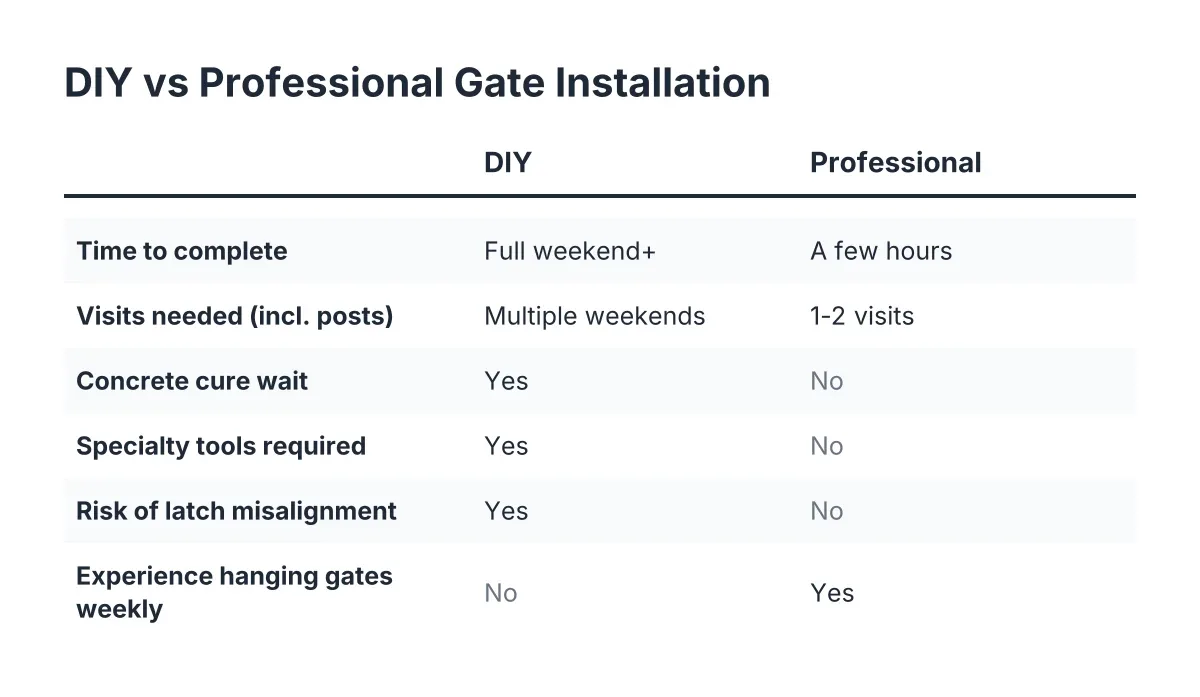
How long does it take to install a gate? A professional crew typically hangs a standard walk gate in a few hours once the posts have cured, and handles the full job, posts included, in one to two visits. A first-time DIYer should budget a full weekend for the same gate, plus concrete cure time before the gate can hang.
That gap is not about working fast. It is about not making mistakes that force rework. Here is where DIY time actually goes:
- Layout and measuring. Getting the gate opening right, accounting for hinge and latch hardware clearance, usually takes longer than expected. Measure the opening wrong by an inch and nothing after it works.
- Digging post holes. In Knoxville clay and rocky ground, two post holes can eat half a day with hand tools. Hit rock and you may need a digging bar or a rented auger.
- Setting posts and waiting. Concrete needs time to cure before it can carry a swinging load. Hang the gate too soon and the hinge post shifts, and you start over.
- Building or squaring the gate. Pre-racking the gate and temporarily screwing the hinges to the rails holds it in the right squared position before final hanging. Skip that step and you fight the gate the whole way.
- Hanging, latching, and adjusting. This is where most DIY gates go wrong. Hinge placement, swing clearance, and latch alignment all interact, and fixing one often throws off another.
Suppose a homeowner in Farragut starts a pool gate project on Saturday morning with a toddler's birthday party three weeks out. Digging two holes in dry summer clay takes until mid-afternoon. Concrete cures through the week. The next Saturday goes to building and hanging the gate, and Sunday goes to figuring out why the self-latching hardware does not catch. In that scenario, the project consumed two full weekends, and the latch still needs adjustment. A crew that hangs gates weekly would have handled the same work in a fraction of the time, with the latch engaging on the first try.
The Tool Gap Between DIY and a Professional Gate Installer
Most homeowners own a drill, a level, and a circular saw. That covers maybe half of a gate project. The rest of the list is where DIY budgets quietly grow:
- Post hole digger or power auger, plus a digging bar for Knoxville's rocky pockets
- A long level or post level, since a short torpedo level will not catch a slow lean
- Clamps to hold the gate at the correct height and gap while you mark hinges
- String line and stakes for alignment with the existing fence
- Concrete mixing tools, or a wheelbarrow and hoe at minimum
- Specialty bits and drivers for gate hardware, especially vinyl and aluminum
For a wood fence gate, that list is manageable if you already do projects. Vinyl and aluminum raise the bar. Vinyl gates, for example, benefit from internal reinforcement; adding a metal insert inside the gate uprights gives the screws something solid to bite, which keeps hinges from pulling loose over time. That is the kind of detail that does not appear in the hardware store instructions but makes the difference between a gate that lasts and one that sags in two summers.
Tool rental changes the cost picture too. Renting an auger for a weekend, buying a bag count of concrete you have never estimated before, and replacing a stripped hinge kit can close much of the gap between DIY and a professional quote on a single gate. The savings on DIY gate installation versus professional pricing are real for a skilled homeowner with the right tools already in the garage. For everyone else, the savings shrink fast.
The Skill Question: What Separates a Gate That Works From One That Sags
Skill in gate work is not carpentry talent. It is knowing the sequence and the small decisions that prevent problems you cannot see yet. A few examples of the judgment calls an experienced installer makes without thinking:
Striker placement before hanging. Installing the latch striker first can help position the gate correctly during hanging, since the striker effectively self-aligns the gate. Most DIY instructions do it backwards, hanging the gate first and then chasing the latch.
Planning for ground movement. Soil settles and shifts, so a smart installer sets the latch striker with room for the gate to drop slightly over time and still catch. On a pool gate, that detail decides whether the gate self-latches next spring or swings open behind a distracted adult.
Reading the site. A gate butting against another fence, working around a tree, or sitting on a slope needs a different post strategy. In tight spots, a reinforced post built around a metal pipe can carry loads a standard post cannot. Sloped lots, common in the foothills around Knoxville, complicate swing clearance in ways a flat-yard tutorial never mentions.
None of this is secret knowledge. All of it is learnable. The honest question is whether your first gate is the right place to learn it, especially when the gate guards a pool.
When the Gate Guards a Pool, the Stakes Change
For most gates, a DIY mistake costs you a sagging latch and a weekend of rework. For a pool gate, a mistake can cost you a failed inspection, an insurance problem, or something far worse. Pool barriers have specific requirements: the gate must self-close, it must self-latch, it must open away from the pool, and the latch must sit where a small child cannot reach it. Local rules vary, so confirm current requirements with your local codes office before you build, and check whether upcoming inspections in the Knoxville area will check latch function, not just latch presence.
Self-latching hardware is less forgiving than a standard latch. Two way gate latch types, which catch whether the gate swings in or out, help in some layouts, but pool code generally dictates swing direction, so hardware choice has to follow the rules rather than convenience. Spring hinges and closers also need tension adjustment so the gate closes firmly enough to latch from any open position, including a gentle two-inch push. That adjustment takes patience and a feel for the hardware.
If you are browsing pool fence ideas online, notice that the photos never show the part that matters: whether that beautiful gate actually latches by itself every single time. A pool fence with a gate that latches most of the time is not a safety barrier. It is a false sense of security.
This is the one scenario where the recommendation is simple. If the gate protects water and children, hire it out, or at minimum have a local fencing contractor inspect your DIY work before the inspection date. The cost of professional gate installation is small against the risk of getting this one wrong.
Where DIY Genuinely Makes Sense
Not every gate needs a professional, and a trustworthy fence company will tell you that. DIY is a reasonable choice when most of these are true:
- The gate is a standard walk gate in a wood fence, not a pool gate or a wide driveway gate
- The posts already exist, are plumb, and are solidly set
- The ground is level and the soil is not fighting you
- You have built outdoor projects before and own most of the tool list
- Nothing is riding on a deadline or an inspection
Replacing a sagging wood gate between two sound posts is a satisfying Saturday project. Repairing a latch, swapping hinges, or adding an anti-sag kit is even easier. For a property manager, small gate repairs across a community can often be handled by maintenance staff, saving the professional budget for the work that needs it.
However, the calculus flips when posts have to be set, when the gate is heavy, when the ground slopes, or when code compliance is on the line. Driveway gates, vinyl and aluminum gates, pool gates, and anything automated all land firmly on the professional side of the line for most homeowners.
What Property Managers Should Weigh Differently
For an HOA board or commercial property manager, the DIY question is usually not about personal labor. It is about whether to assign gate work to in-house maintenance or bid it to a fence company. The amenity gate at a community pool is the highest-liability hardware on the property, and it takes more abuse than any residential gate because dozens of families cycle it daily.
Say an HOA in West Knoxville has a pool gate that stopped self-latching sometime last season, and nobody is sure when. Maintenance could swap the latch in an afternoon. But the real problem may be a leaning hinge post, worn spring hinges, or a gate frame that has racked out of square, and a latch swap on a racked gate fails again within weeks. In that scenario, a professional assessment costs little against the liability of a pool barrier that does not work, and it produces documentation the board can keep on file.
For capital projects, replacing an aging perimeter fence or pool enclosure, the bid process should ask specifically about gate construction, not just fence footage. Gates fail first, and the difference between bids often lives in gate framing, hinge quality, and post setting rather than in the panels. The cheapest bid on a community fence frequently costs more over the life of the asset because gates built to a price point get rebuilt years sooner. For context on material-level fence pricing, Angi reports wood fencing runs about $11 to $45 per linear foot for professional installation, with vinyl starting around $15 to $40 per linear foot; gates add cost on top of those footage rates because of the hardware and labor involved.
Making the Call: An Honest DIY vs. Professional Checklist
Here is a plain way to decide. Answer these five questions:
- Is this a pool gate or any gate tied to an inspection? If yes, go professional, or get professional review before inspection day.
- Do the posts exist and are they sound? New posts in Knoxville clay and rock are the hardest part of gate installation; if you are setting posts, lean professional.
- Is the gate wider than a standard walk gate? Weight grows faster than width. Wide gates sag without engineered bracing.
- Do you have two free weekends and the tool list? If the honest answer is one Saturday and a drill, the DIY savings will evaporate into rentals and rework.
- What does failure cost? A sticky garden gate is an annoyance. A pool gate that does not latch is a hazard. Match the installer to the stakes.
There is a real trade-off either direction. DIY costs time, tool money, and the risk of redoing work, but it builds skill and saves labor cost on simple gates. Professional work costs more upfront, but it buys precision on the parts you cannot see, posts set for this soil, hardware adjusted to keep latching as the ground moves, and a gate that still swings true after a few East Tennessee winters.
For the parent staring down a pool inspection deadline, the answer is already clear. Spend your energy on picking the fence style and latch hardware you want, and let someone who hangs gates every week handle the part where a half inch decides whether you pass. For everyone else, the checklist above will land you on the right side of deciding between DIY versus professional gate work, and either way, you will know exactly what the project is asking of you before you start digging.
If you need gate installation and repair, Knoxville Fence Builders can help.
Prefer to talk it through? Call (865) 419-3997 — a quick call is usually the fastest way to get a straight answer for your situation.