
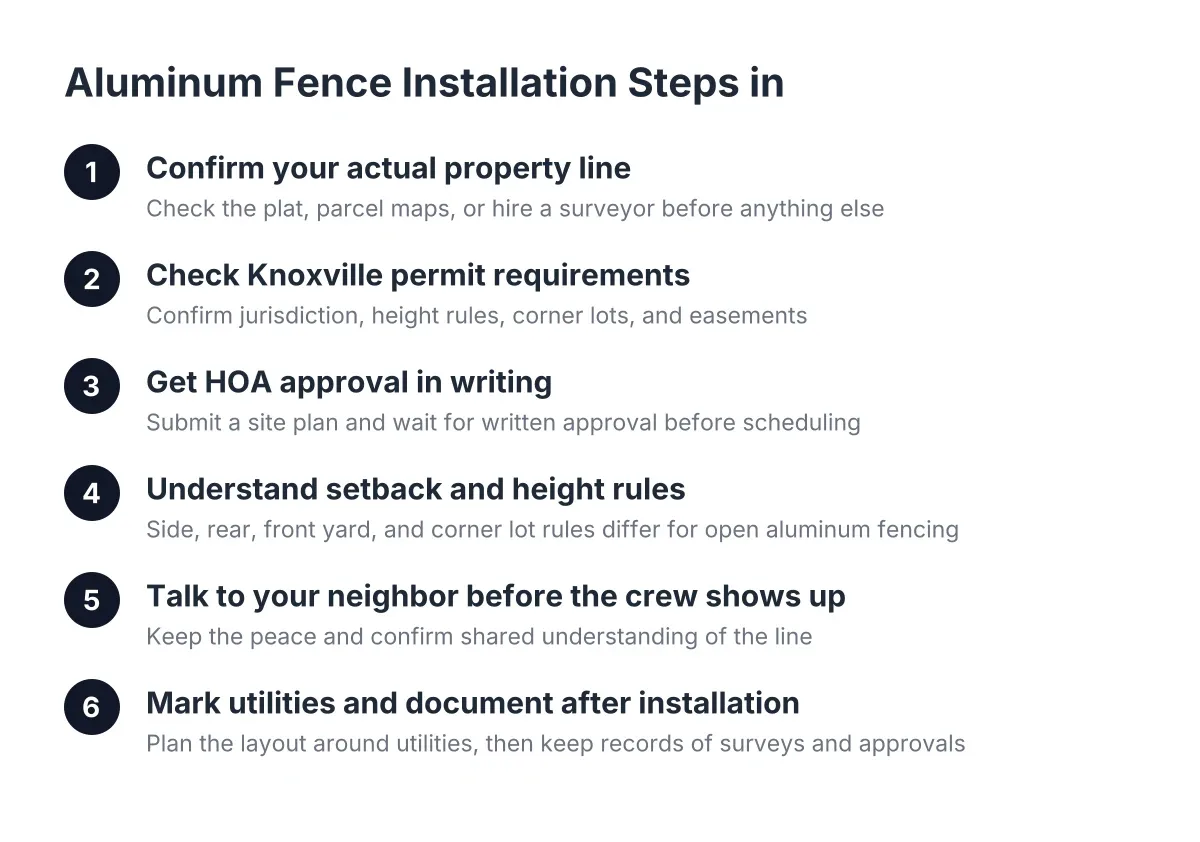
Aluminum Fence Installation in Knoxville: Permits, Setbacks, and Property Lines
You picked aluminum. Good choice for East Tennessee: it does not rot in our humid summers, it shrugs off freeze-thaw winters, and black aluminum fence panels look sharp against both older in-town homes and newer subdivision lots. But before any posts go in the ground, aluminum fence installation in Knoxville runs through a set of rules most homeowners never think about until a neighbor complains or the HOA sends a letter. Permits, setback rules, property lines, and pool codes all decide where your fence can legally go.
This guide walks you through the paperwork and placement steps in order, so you install the fence correctly the first time and never have to move it. If a neighbor just put up their own fence, or you bought a home with an unclear property line, this is the sequence that keeps the peace and protects your money.
Step 1: Confirm Your Actual Property Line Before Anything Else
Do not trust the existing fence, the mow line, or what the previous owner said. Fences get built in the wrong spot all the time, and a fence that crosses the line is the single most expensive mistake in this whole process. You could pay for installation twice: once to build it, once to move it.
Start with your plat. If you bought recently, your closing documents likely include a recorded plat showing lot dimensions and any easements. You can also pull parcel maps through the Knox County property assessor's online tools, which help you orient yourself but are not precise enough to build from.
If the line is disputed, unclear, or the stakes are high, hire a licensed surveyor to mark the corners with pins or stakes. Yes, a survey is an added cost on top of the fence. Weigh it against the alternative: suppose a homeowner in Fountain City skips the survey, builds a fence they believe sits on the line, and a neighbor's later survey shows it sits two feet over. In that scenario, the homeowner pays to tear out posts set in concrete, reset them, and patch the yard. The survey would have been the cheaper problem.
A few practical rules once you know the line:
- Set the fence a few inches inside your line so posts, footings, and concrete stay entirely on your property.
- Keep copies of the survey, plat, and any written agreement with your neighbor. Documentation settles future arguments before they start.
- Never assume a shared fence means shared ownership. Who pays for a fence between neighbors depends on agreement, not law, in most residential cases here.
Step 2: Check Knoxville Permit Requirements for Your Address
Permit rules for a fence depend on where you live, how tall the fence is, and whether it encloses a pool. City of Knoxville addresses and unincorporated Knox County addresses follow different offices and different processes, so your first job is confirming which jurisdiction you are in. Your property tax bill or the county parcel map tells you.
Then make three calls or web searches before you order materials:
- Ask your local zoning or codes office whether a residential fence at your planned height needs a permit. Taller fences and pool enclosures often trigger review even when a standard yard fence does not.
- Ask about corner lot rules. Corner lots in Knoxville commonly face sight-triangle restrictions near intersections, where a fence cannot block a driver's view. Height limits near the street are usually stricter than in the backyard.
- Ask whether your planned fence sits in any easement, especially utility or drainage easements. You can sometimes fence over an easement, but the utility can remove the fence to access it, at your expense.
As of 2026, rules can change with code updates, so verify current requirements directly with the city or county rather than relying on an old forum post. A local fencing contractor who works in Knoxville every week will also know which addresses tend to trigger review, but the legal responsibility for permits sits with the property owner.
Step 3: Get HOA Approval in Writing
If your neighborhood has an HOA, its rules apply on top of city and county rules, and they are often stricter. Many Knoxville subdivisions require an architectural review application before any fence installation, and some specify material, color, and height. Black aluminum is one of the most commonly approved styles because it reads as decorative rather than imposing, but do not assume.
Submit your application with a site plan showing the fence location, the style, and the height. Wait for written approval before scheduling installation. However, do not treat HOA approval as a substitute for the property line work in Step 1; an HOA approving your plan does not mean the plan sits on your land.
Step 4: Understand Setback and Height Rules for Aluminum Fence Installation
Setback rules control how close to the property line, street, and sidewalk your fence can sit. In most residential zones, side and rear fences can run at or near the line, while front yard fences face lower height limits. Corner lots, as noted above, carry extra restrictions near the intersection.
Aluminum has one advantage here. Because it is an open-picket style rather than a solid privacy fence, some height and placement rules treat it more leniently than a solid wood fence or vinyl fence panel. Open fencing does not block sight lines or airflow the way solid panels do. Confirm the specifics for your zone, but expect an open aluminum fence to have more placement flexibility than a six-foot privacy fence.
Pool Fences Follow a Stricter Standard
If the fence encloses a swimming pool, a separate layer of code applies, and it is not optional. Pool barrier rules generally dictate minimum fence height, maximum gaps under and between pickets, and pool gate hardware: the gate must self-close and self-latch, with the latch positioned out of a small child's reach. Aluminum handles these requirements well because panel and gate hardware designed for pool code is widely available, but the layout and gate installation must be done to spec. If your project includes a pool, tell the codes office and your installer up front.
Step 5: Talk to Your Neighbor Before the Crew Shows Up
Nothing in Knoxville law requires you to notify a neighbor before building on your own land. Do it anyway. A five-minute conversation prevents most fence disputes, and it costs nothing.
Show them the survey pins, explain the fence sits inside your line, and share the style you chose. For example, if their fence already runs along part of the shared boundary, discuss how yours will meet or offset from it so you do not create a strip of no-man's-land that neither of you can mow. Butting a new fence against an existing one takes planning; installers sometimes need reinforced posts or adjusted spacing to make the junction clean, so flag it early.
Put anything you agree on in writing, even a friendly email. If the neighbor relationship ever sours or either house sells, that paper trail is worth more than memory.
Step 6: Mark Utilities and Plan the Aluminum Fence Installation Layout
Call 811 before any digging. It is free, it is required, and buried gas, water, and cable lines do not care how careful your shovel is. Utility locators mark the lines within a few business days.
Next, plan the post layout. Aluminum fence post installation in Knoxville comes with ground conditions that surprise DIY kit buyers: clay that turns to concrete in a dry August and soup in a wet March, plus rock shelves that stop an auger cold. Posts need proper footings; backfilling a hole with tamped dirt and no footing is a shortcut that fails, and it fails fastest on gates. Measure post spacing center to center, not edge to edge, so panels seat consistently.
Slopes add another wrinkle. On the hillside lots common in the foothills around Knoxville, rails may not reach into the post routing at full panel length, so post spacing has to tighten on steep grades. Plan cut or shortened sections for the least visible stretches of the yard and save full panels for the areas you see from the street and patio. This is where professional aluminum fence installation earns its cost over a DIY kit; a crew that works sloped clay lots weekly already knows where the layout will fight back. That said, a confident DIYer with a flat lot, soft soil, and no pool code in play can handle a small run; a sloped lot, a pool enclosure, or a disputed boundary is where a professional protects you.
Step 7: Document Everything After Installation
Once the fence is up, close the loop on paperwork. Keep the survey, the permit or the written confirmation that none was required, the HOA approval, photos of the finished fence and its position relative to the survey pins, and your installation receipt. Store digital copies.
This file is your insurance against the exact problem that started your search. If a future neighbor questions the line, if the HOA changes boards, or if you sell the house, you can show in minutes that the fence was placed legally and built to code.
Common Questions About Knoxville Fence Placement Rules
Do I Need a Survey Before Installing a Fence?
A survey is not legally required to build a fence in Knoxville, but it is the only reliable way to know where your property line sits. If your corners are already pinned and undisputed, you can work from those. If the line is unclear, contested, or the neighbor relationship is tense, a survey is cheap insurance against rebuilding the fence.
Who Pays for a Fence Between Neighbors?
In Knoxville residential settings, the person who wants the fence generally pays for it, and the fence belongs to whoever's land it sits on. Tennessee does not force a neighbor to split costs for a typical yard fence. If a neighbor offers to share the cost, get the agreement, the placement, and future maintenance duties in writing.
Can My Neighbor Make Me Move a Correctly Placed Fence?
No. A fence built entirely on your own property, with any required permit and within setback rules, is yours to keep. This is why Steps 1 and 2 matter more than any other part of aluminum fence installation; the fence that is documented and placed correctly the first time is the one nobody can make you move.
Prefer to talk it through? Call (865) 419-3997 — a quick call is usually the fastest way to get a straight answer for your situation.